Change the way you think about yourself


self-covering-your-eyes

The way we feel about ourselves is actually much more important than how we think about ourselves; but in order to change how we feel, we have to change how we think about ourselves.  If you feel like you are not worthy, a failure, ugly, or despise yourself, chances are that it is because you think badly about yourself.  However, thoughts can pop into our minds and leave, but feelings linger and they are the most important to our self-esteem and confidence.  If you’ve made some poor decisions in the past, you may hate the former you and feel extremely shameful for what you have done.  If you hate the way you look, you may feel guilty for how your body got there and the lack that you are doing to change it.  If you cannot form meaningful relationships with others, you may feel as if you are not worthy of being loved because you don’t love yourself.

First off, who is benefiting from you thinking this way?  Are you?  You gain nothing by constantly beating yourself up for things no one else can see.  You are fighting an imaginary war in your mind and you are always the loser, but no one else can see this and wonder why the beautiful girl at the bar thinks she’s ugly because her boyfriend tells her so he can lower her self-esteem so she won’t leave him.  Or the girl you are with doesn’t understand why you can love her, but it is you won’t allow her to love you even when she is giving you her entire world because you think you are not worthy.  You are the only one holding yourself back when you continue to feel this way about yourself.  If you don’t care about yourself and forgive yourself, you will never allow others to do the same.

If you are ready to move on, forgive yourself for all that you’ve done wrong.  That doesn’t mean you forget, but you let go of the shame.  Every time you bring up that memory, you recall the shame and it is not healthy.  Instead, connect a positive thought to it so that when you bring it up, you remind yourself of the positive thought and you’ll find that the shame disappears.  The memory has not changed, but your feelings about it have.  Learn to love all your faults that you see in yourself.  Everything that is imperfect about you and all the setbacks you’ve experienced have made you exactly who you are.  When you learn to love your detracting values, you will see the beauty in who you are.  Value your voice and your time.  Recognize that you hold power in your voice and that people seek to own power, so you must make sure you are heard.  People are forever in stages of flux, and you must know that if someone doesn’t value your time that you are investing, they are not worth your investment, for life is too short to spend your time on people who do not care about you.

If you are not your own best friend and cheerleader, who do you expect to be that person for you?  You may think it’s egotistical to believe the very best in yourself, but that’s because you’ve been at the other end of the spectrum and believe the very worst in yourself and the light at the end of the tunnel always looks scary from the other side.  When you think of yourself as someone whom you would want to be with, you will have finally accepted yourself for who you should be.


Never Betray Yourself

backlit-tree-sunlight_23017_600x450

If there is just one thing you should do in your life, it is to never betray yourself.  Learn to believe in the power of your own words and live by them.  If you ever criticize someone else for an act, do everything in your power to never do the same thing.  This has a two-fold effect, for you  don’t become a hypocrite and you are more cautious of what you say about others.  You will never live up to the standards of someone else, but you can live by your own standards and if you can, you can be proud in that fact.  You can set your standards really low and get away with everything, but eventually, you’ll find that you’ll criticize someone for doing the same thing, and betray yourself in the process.  You are free to judge others for their actions as long as you make sure you never commit the same things for as long as you live.  If you do, then you must have more compassion for the people you judge.  What this does is limit your judgement because you are also judging yourself in the process.

When you can achieve this feat, you will gain a tremendous amount of pride in who you are because you know what kind of person you are.  It will show in the way you carry yourself, the way you talk, and how you allow others to treat you and you they.  You will value yourself and your word and others around you will take you at your word.  They will recognize the confidence you have in yourself and be drawn to that without knowing why.  You will be able to influence others through your actions and words and possibly change the world.  There will always be people who will betray you, let you down, or take advantage of you, but don’t let that person be you.  Do not cheat yourself out of becoming the best version of you that you can become.  When you  have this much pride in who you are, you can look anyone in the eye and know your own worth and make them see it as well.

Is what you’re doing now working?

out_of_the_dark_____by_mosredna

They say you should be grateful for what you have and appreciate where you are, but some of us can’t do that when we’re holding on to so much. It’s not even a possibility that you can appreciate what you have because you feel you have nothing.  So, how do you change this mindset when it’s your reality?  People who can be grateful don’t understand these people because they have learned to be grateful, but how can someone who has never been taught start?  Most of the time, these people want to change, but also refuse to change because they think it will result in more of the same: disappointment and they’re used to disappointment.  Why change if it’s all the same?  I want to say to them, ‘Is what you’re doing now working?  How long have you been doing it?  Do you want a different outcome?’  If you know you’re not happy, the biggest step is changing your thought patterns.  You’re used to being negative about everything, including yourself, so you immediately bat down suggestions that may help you.  If you are happy being unhappy, keep on doing what you’re doing, but if you’re not, you’re going to have to agree to being uncomfortable.  Agree to embarrassment.  Agree to the unknown.  And agree that there is another possibility out there that you haven’t considered.

It’s easy to say ‘If you’re not happy, change something,’ to these people when you can change, but they can’t because they fear change. They don’t like where they are, but they also fear change even more because they have a fear of the unknown.  When you are not confident with who you are, you are not confident with the future.  Accept that the path to change is littered with fear, shame, and sadness, but it is only because you’ve been avoiding all these feelings for so long that you feel them full-force once they come.  Once you accept it, you’ll see that embarrassment is a state of mind.  You’re only embarrassed for as long as you let yourself be.  Do not let these things hold you back from who you can be and where you can go.  The only way to combat fear, shame, momentary sadness, and embarrassment is to face them until they become meaningless and lose a grip on you.  I see that these things can c ripple people and the greatest tragedy is not that they didn’t get what they wanted, but that they didn’t become the person  they were meant to be.  The person they were meant to be is someone who accepts themselves for exactly who they are, but are always striving to be better.  There is just one correlation amongst people who are not happy who don’t live in extreme conditions: they are not happy with themselves.  They don’t know how to be happy and if someone were to show them the way, the way would look treacherous to them and they would refuse to take it.  But I ask you once again, is what you’re doing now working?

What makes someone charismatic?

prince-performs-1985-purple-rain-tour-color-billboard-650

After Prince passed away, comedian Donnell Rawlings told a story about meeting Prince and relaying that it felt as if Prince was drawing him in and he couldn’t look away because he was so beautiful.  One of Madonna’s friends said that Madonna had the ability to make anything look good.  She once threw away a shirt only for Madonna to take it and somehow made the shirt desirable again to the original owner by the way she wore it.  People who are charismatic have the ability to appear strong, desirable, and powerful without exerting any effort, but what makes them charismatic?  Most of these people were born this way and do not know any other way of being, for they simply are.

From a young age, they have always had a high sense of self-esteem and self-worth.  They valued who they were and it showed in how they spoke, how they carried themselves, what they wore, and how others viewed them.  When a person is charismatic, they believe they are the very best at who they can be, and exude this confidence.  When others see them, they are attracted to this insanely high level of confidence.  They may not even be as beautiful, intelligent, or fashionable as someone else, but the viewer attributes these things to them because of how confident they are.  Being charismatic means having solid belief in yourself.

These people know who they are and value themselves for it.  They will not accept less from themselves or others.  Unfortunately, most of them were born this way, and do not know how to relay this sense of importance on to others.  If someone was born charismatic, they will never be able to teach someone else to be charismatic because they didn’t learn how to.  At the core, being charismatic means loving yourself so much that you become confident in this fact to the point that others take notice.  To love yourself means to forgive your past mistakes, accept who you are, and to be your own best friend.  Ultimately, you have to be proud of who you are, your current decisions, and where you are going.  That is true charisma.

When the universe cheats you of your soul mate

shadow-17

A lot of people feel cheated because they didn’t end up with the one they thought they should be with. They end up jaded and feel as if they are owed something.  I can tell you many things such as you’re only hurting yourself or you’re not really opening yourself up to new opportunities, but I know this will not change your mind.  I can tell you that if you don’t change the way you think about being cheated, you will eventually find someone new.  Someone who will try hard to prove to you that they’re just as good as your ex, and you’ll dismiss them because you feel cheated that you didn’t get what you wanted.  They will try harder to make you love them and you’ll try harder to make them leave until they finally do leave you.  And then, you’ll realize what you did and try to win them back, but it’ll be too late.  I’ve seen this happen a million times and a million times it’ll happen again.  The one that got away is just a person.  You may have felt as if they were your soul mate, but they obviously didn’t see you as theirs.  When you continue to feel cheated, you cheat yourself out of a new relationship.  Instead, feel grateful for what you had and lost.  If you continue to feel like the universe owes you, you’ll always be hurt and that means that you let the shadow of someone from your past control your feelings.  Why give this imaginary figure the power of taking your happiness?  For that is all they all: an imaginary figure you’ve built into something  untouchable that no mere mortal can live up to anymore, not even your ex.

Is the veil oppressive to women?

purplewithtrim_grande

I see pointed attacks in comments section sometimes that say the veil is an affront to women’s rights and that they should be removed.  Some would say they seem to be one step up from a burqa, and I do agree with parts of this sentiment.  If you take the religion and culture out of it, what is the underlying meaning of the hijab?  It is to promote modesty in women.  If you subject one sex to rules of decorum and not the other by having themselves cover themselves, it is a form of control.  Those who practice the religion certainly have  the right to wear or not wear it, but the idea in itself translates to taking away the power of beauty from women.  There is power in beauty and there are those who seek to control it.  I do agree with some commenters about this point, but not on the vocalization of telling them they need to take it off.  Although it is oppressive, it is their right to wear it due to their freedom to choose their religion.  There are plenty of other religions that subject women to conformity such as certain Mormon sects.  There are also many societal and cultural practices that are oppressive that I openly subscribe to such as wearing high heels that destroy my feet all for the sake of reaching an unattainable beauty.  I agree it is oppressive, but they also have the right to wear it and I do not have the right to say anything to them because I choose to drape myself in oppressive ideas and clothing.

Age Ain’t Nothing But A Number

aaliyah-age-aint-nothing-but-a-number-thatgrapejuice

Anyone who’s kinda old(like me) remembers Aaliyah’s song Age Ain’t Nothing but a Number and her famously short-lived marriage to R. Kelly. So, does age matter in the realm of love?  You can definitely fall in love with anyone of any age, background, color, or whatever other signifiers you want to speak of, so in that sense, no, age does not matter concerning who you love.  However, the proponents of those who argue it are also implying that it doesn’t matter in a relationship, and that is flat-out wrong.  To set it straight, age does not matter where love is concerned, but it sure matters in a relationship.  In a relationship, your age, background, color, and whatever signifiers you want to speak of do matter because it is all these things that make you who you are.  Love itself can be colorblind, but you must be blind if you can’t acknowledge your differences in a relationship.  Age does matter because those who are young are still highly impressionable and have little to no understanding of their own needs let alone what the needs of a relationship entails.  Because they do not have the learned experience of someone older, it is much easier to manipulate these individuals if the other party is significantly older.  You can continue saying age doesn’t matter, but do not imply it relates to the relationship as well.

‘Small business’ is a term coined by the rich elite to make you agreeable

hands.png

I remember hearing about the tax hike that would be implemented for people making 250,000 or more and watching my boyfriend’s family freak out over that. Why?  At no time in their lives were they ever going to make that much money.  This is five times the national average, and just 2.9 percent of couples earn that much or more. They asked me if I thought it was unfair and I said that if I ever made that much money, I would feel I would need to pay my fair share of taxes.  And then they went on about how small businesses who could be crippled by this tax.  I thought it was ridiculous that they were worrying about things that rich people would have to worry about.  That is exactly how the rich get you to agree with them: by getting you to empathize with their causes.  Taxes on the rich?  Just tell them small businesses will suffer and that if they ever make that much money, they’ll have none left after these taxes.  Really?  How is it that these people can care so much for the rich but not care to extend welfare and medical aid to the poor?  In actuality, both may not affect you on a daily basis, but when you help the rich, you only help the rich.  Que trickle-down economics by Reagan .  When you help the poor, you end up helping the community as a whole.

My boyfriend’s family went on to scoff at those who were on food stamps and how some people take advantage of the system, although they themselves had benefitted from it for a short period of time. I agree that there are some who take advantage of the system, but should everyone suffer because of these few?  Why would you scrap a whole system that at one point also helped you?  They didn’t realize that that is what food stamps were for:  people just like them who needed it for a short period of time in their lives.  Instead, they saw the recipients as leaches who would suck the system dry.  How have we come to this stage where some of us actively agree with the politics of the rich and deplore the poor for asking for help? We need to change the way we think about who we are really helping in thinking this way.  Who is actually benefitting from this propaganda?  If you say you care about the average worker and his rights to own a small business, also know that his small business includes worker who benefit from help from the government.  The term ‘small business’ is just really a term bandied about by the rich elite to make the middle class more tolerable to laws and policies enacted to help the rich elite keep their money.

Greed is prevalent in all societies, not just ours, but the trick is to realize this and not deny it. Those who are rich will continue to strive to keep their riches.  Those who are poor will always need to ask for help.  If they were switched, they would do exactly the same.  Greed is a part of human nature, but some who are rich are quick to condemn the poor for wanting hand-outs and some who are poor are quick to condemn the rich for their avarice, but the only thing that can solve the problem is the understanding that we all succeed when the poorest of society succeeds through compassion.  Compassion is what is needed to elevate our society beyond the greed of individual gratification.  If we were all to benefit, there would be more advances in medicine, new innovations in technology, and immensely more thought-provoking art, for the only thing keeping us from these things is the opportunity for more people to get there.


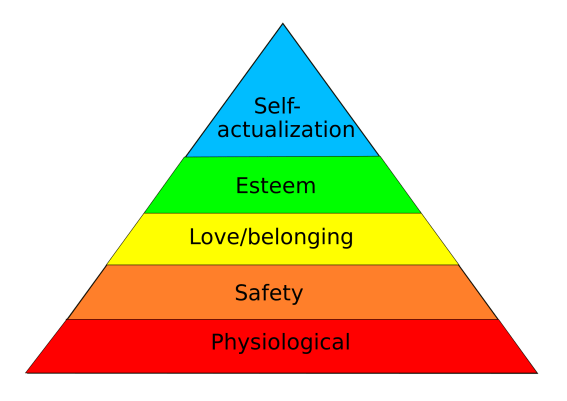
What’s missing from Maslow’s theory?

2000px-maslowshierarchyofneeds-svg

Maslow’s A Theory of Human Motivation states:

Esteem needs –‘All people in our society…have a need or desire for a stable, firmly based, (usually) high evaluation of themselves, for self-respect, or self-esteem, and for the esteem of others.  By firmly based self-esteem, we mean that which is soundly based upon real capacity, achievement and respect from others.  These needs may be classified into two subsidiary sets. These are, first, the desire for strength, for achievement, for adequacy, for confidence in the face of the world, and for independence and freedom.  Secondly, we have what we may call the desire for reputation or prestige…recognition, attention, importance or appreciation.’

I would further break down self-esteem into two categories, but my interpretation would first include how we feel and view ourselves and the other as the desire for the recognition of our strengths.  However, the first is NOT a motivation.  We are motivated to want prestige, fame, and acknowledgement, but self-esteem has never been a motivation for people.  People do not consciously know that they want to see themselves in a positive light, nor do they actively try to achieve this goal.  As children, we may or may not be encouraged to develop a sense of who we are, but many people vary in the degree of seeing how important self-esteem is.

First off, what is self-esteem?  How is it different from self-respect?  Is there a difference?  Yes.  Some people respect themselves highly and know they would never let someone else disparage them, but if they have low self-esteem, they may still believe it.  The two can exist independent of each other, however, those who have high self-esteem usually respect themselves as well and will usually also have high self-respect, but those who have low self-esteem can still respect their selves outside of who they are, which is also correlates to high self-respect. Whereas self-respect plays to how a person is treated by others, self-esteem plays to how a person treats themselves based on how they feel about themselves.  This is why it may be confusing at times when you confuse the two and mistake them for one another.

Some children are encouraged to enjoy who they are and they flourish.  Some may be discouraged, but more often than not, the majority are ambivalent, not because parents do not care, but because they don’t know how to encourage a reticent child.  As such, this insular world becomes even more insular as they internalize feelings and don’t understand the importance of self-esteem.  Because it is not a motivation, they do not build who they are.  They are still motivated to seek friends and love interests, but if they are not fulfilled internally by themselves, their relationships can be rocky because of this.  Many times, we are searching for a sense of ourselves throughout our journey and take on relationships we can’t comprehend in the search for what we want.  If we are not sure in who we are, we will be as equally unsure in who we want as a partner, causing rifts.

Some who are socially-withdrawn feel no need to develop their self-esteem.  They may regard themselves highly, but do not feel the need to elevate how they feel about themselves, thus they do not feel satisfied in this area and will not pursue other relationships or achievements because they feel as if they are not good enough.  They come up with reasons for this such as they despise human connections and they feel they are wasting their time and energy on useless things.  In actuality, humans crave relationships because they will undoubtedly feel lonely at some point despite their refusals.  Having self-esteem encourages these individuals to reach out to others because they feel they deserve relationships.

Why is it important?  It’s important because it serves as the basis of who we are.  When we have incredibly low self-esteem, we tend to accept less and feel fearful of other’s motivations and change in itself.  We are unsure of what the future will bring.  When we have high self-esteem, we welcome change and become more adaptable.  We have a more positive outlook on life and what comes our way.  Most importantly, we care about ourselves and are more in tune with who we are and what we want if we are honest with ourselves.  Ultimately, high self-esteem allows us to be the truest form of who we are and having pride in ourselves internally.

An example would be if a young adult asks someone out and gets rejected.  This is not a poor decision, but it retains a negative worth to them.  As such, they may let this memory eschew them and steer other decisions in their live.  We can tell them that at least they were brave enough to ask.  Some people go their whole lives without knowing a simple question, and they did ask.  The answer was no, but that doesn’t mean it doesn’t have meaning.  It means they were brave.  It means they have the ability to interact with others.  It means they have learned something.  When they don’t look upon the decision as shameful and fearful, they will see the pride of it and see pride in themselves.  This allows for them to see their decisions as positive memories that have enabled them to grow.

Maslow’s heirachy did not state that this was a strict hierarchy where each lower need had to be met before moving on to the next, but it was predicated on the belief that people are motivated to want self-esteem.  If people were motivated on this belief and chose to fulfill this need, they would definitely be able move on, but it is not a motivation.  Thus, some people who did not already possess high self-esteem would not be able to reach self-actualization.  The need for recognition and meaningful relationships would still exist, but these needs would not be fully realized if the person could not realize their own self worth.  What this results in is people searching for love, but either treat themselves or their partner badly because they feel they are not worthy.  Or they fail to advance at work because they fear change and authority.


How do we cultivate self-esteem?  Is it enough to just encourage children and tell them they are good?  No, because a parent can do this and a child can still have low self-esteem, which can be quite maddening for the parent.  The trick is teach them how to view their decisions and discuss them.  If it is a good decision, praise them for it and discuss how it affects those around them.  This allows for them to see how their actions affect not only them but those around them.  If they made a poor decision, we should talk about what went wrong, why it went wrong and how they felt about it.  Let them know the positives of a poor decision.  They at least have learned something from it.  They are wiser and richer for knowing it now.  The poor decisions are where we can cultivate the most self-esteem, which sounds counter-intuitive, but is not.  When we reinforce that poor decisions are part of the learning process, they see failure as necessary and not shameful.  When the shame is removed, they are able to see the nugget of good in the poor decision and learn from it.