The Guise of God

church-1515454__180

I distinctly remember the story of Abraham being called by God to take his son to the mountain to kill just to prove his allegiance to him.  And I thought, man, God is a dick.  What asshole wants his flock to follow all of his directions without question just to prove their faith?  But that story worked, because the people I grew up with never questioned the will of God, and what’s more, they never questioned the mouthpiece of God: the church elders.  I believe in God, but I refuse to believe in religion.  It is man who subverts religion for his own gain, not the greater good of God.  When a mortal tells a susceptible person this story and then asks them not to question them as well, the person is turned into a sheep.  They follow the direction of a mortal, not God, without question.

If you question the person, you question your own faith by their logic, so you simply go along as Abraham, hoping that God will show you the reasoning for his actions later, but it is not God who is directing you, but man.  It is man who uses this story to make you more docile to his wishes and to curb your questioning.  And what happened to these people I grew up with?  When faced with a threatening situation, they simply opt to pray because they so whole-heartedly believe in the power of prayer alone.  They don’t even seek out other avenues because they have been hard-wired to put all their faith in God.  And seriously, if God ever asked me to take my child to the mountain to kill, I may ask what for.  When we are conditioned to not question, we lose the ability to objectively see reality.  Whatever your beliefs are in God, do not place your trust blindly, especially in mere mortals who use the guise of God.


‘We are all the same’ is BS

we-are-all-the-same-on-the-inside-shin-1050x700

I think a lot of people were well-intentioned a few decades ago when they were trying to combat racism and taught kids my age that ‘we are all the same.’ The people who grew up with this mantra understood the concept of the idea that the color of our skin should not matter in determining who we are as individuals.  However, it also had an unintended side effect, where white people took this phrase to mean that we all have the same experience, and since they didn’t see in color, they didn’t need to acknowledge the differences that we had.  I’m not blaming them, but it is important to note where this notion came from: the best of intentions.  It is mostly benign because they honestly do not see the color of one’s skin, which was the ultimate goal of ‘we are all the same,’ but in doing so, they erased the differences of who we are.  My friend’s husband is White and she is Asian.  He says he does not see her as Asian, and as such, he does not understand when she claims that people at pre-dominantly white establishments treat her differently.  Why would they treat her differently if she is the same as him?  When you fail to see the differences in who others are, you negate their experience.  Because you think that ‘we are all the same,’ meaning we all shared the same upbringing, parenting styles, culture, and so on, you can ignore someone’s experience based on the color of their skin.  And yet, I continue to hear this phrase uttered because it has saturated our youth and now our adult lives to the point where some people don’t understand the phrase ‘Black Lives Matter,’ and instead implore that ‘All Lives Matter,’ which is very close to ‘we are all the same.’

We are the same in our genetics, but we are not treated the same based off of factors we cannot control. To acknowledge and celebrate our differences does not alienate us, but makes us more aware of OUR diversity.  To continue to proclaim that ‘we are all the same’ propagates the idea that differences don’t matter.  It is important not to assign blame and to know that it is not anyone’s fault for believing it, but we do need to educate ourselves on how that phrase has affected society as a whole.  Oftentimes, White people bear the brunt of this guilt and push back because they are weary of being blamed for race relations.  This in itself also needs to be addressed because if it is not, it results in stagnation.  Change comes in not actions, but thoughts.  Change how you view the situation and each other and a revolution can be born.

What does an abusive relationship look like?

o-japanese-woman-crying-facebook

I saw a comment asking why people stay in abusive relationships and that it was their fault for marrying someone who was abusive because they knew they were abusive beforehand.  That’s not now physical and emotional abuse starts.  If you were to go on your first date with someone and the first thing they did was slap you, you would probably not go on the rest of the date, but if this same person were to hit you three months later, you might react differently then.  Abuse happens gradually over time and can happen to anyone.  I believe there are some persons who are more predisposed to abusing others because they feel inadequate about their lives and insecure with who they are.

Abuse first shows up as small signs of control where they limit their mate’s time with others, want to know where they are at all times, and question their safety.  These can have the effect of appearing caring to the other party because they think they are concerned about their well-being.  There are certainly people who do these things and never abuse any one, but those who are pre-disposed to abusing others will eventually escalate the intensity of these acts.  Soon, they will find they are cut off from their friends and family and feel as if they only have their partner to rely on.  It can then escalate to emotional abuse, where the abuser says unbecoming things to lower their self-esteem.  When the person feels like they have no one left and they are not worthy of anyone, they will be more predisposed to being abused.

It starts out with just one slap. Lots of apologies.  Maybe flowers.  Promises that they’ll never do it again, and then they accidently trip you some time.  They say you make them so angry that they punch multiple holes in the wall, blaming you for their actions.  They ask you to change who you are to suit them and their needs, but you find you can never satisfy them.  You constantly doubt yourself and ask how you got into this situation and feel even more depressed about it.  You barely see your friends anymore and when your family asks about that bruise, you lie that you ran into a wall.  You don’t want them to pity you and stop seeing them.  Physical and emotional abuse are an escalation of a system to control a person’s self-worth.  Every time you make a decision to stay, you unknowingly agree to a an even higher level of abuse to keep your self-worth low. The only way to break free is to see value in who you are.

When the universe cheats you of your soul mate

shadow-17

A lot of people feel cheated because they didn’t end up with the one they thought they should be with. They end up jaded and feel as if they are owed something.  I can tell you many things such as you’re only hurting yourself or you’re not really opening yourself up to new opportunities, but I know this will not change your mind.  I can tell you that if you don’t change the way you think about being cheated, you will eventually find someone new.  Someone who will try hard to prove to you that they’re just as good as your ex, and you’ll dismiss them because you feel cheated that you didn’t get what you wanted.  They will try harder to make you love them and you’ll try harder to make them leave until they finally do leave you.  And then, you’ll realize what you did and try to win them back, but it’ll be too late.  I’ve seen this happen a million times and a million times it’ll happen again.  The one that got away is just a person.  You may have felt as if they were your soul mate, but they obviously didn’t see you as theirs.  When you continue to feel cheated, you cheat yourself out of a new relationship.  Instead, feel grateful for what you had and lost.  If you continue to feel like the universe owes you, you’ll always be hurt and that means that you let the shadow of someone from your past control your feelings.  Why give this imaginary figure the power of taking your happiness?  For that is all they all: an imaginary figure you’ve built into something  untouchable that no mere mortal can live up to anymore, not even your ex.

Is the veil oppressive to women?

purplewithtrim_grande

I see pointed attacks in comments section sometimes that say the veil is an affront to women’s rights and that they should be removed.  Some would say they seem to be one step up from a burqa, and I do agree with parts of this sentiment.  If you take the religion and culture out of it, what is the underlying meaning of the hijab?  It is to promote modesty in women.  If you subject one sex to rules of decorum and not the other by having themselves cover themselves, it is a form of control.  Those who practice the religion certainly have  the right to wear or not wear it, but the idea in itself translates to taking away the power of beauty from women.  There is power in beauty and there are those who seek to control it.  I do agree with some commenters about this point, but not on the vocalization of telling them they need to take it off.  Although it is oppressive, it is their right to wear it due to their freedom to choose their religion.  There are plenty of other religions that subject women to conformity such as certain Mormon sects.  There are also many societal and cultural practices that are oppressive that I openly subscribe to such as wearing high heels that destroy my feet all for the sake of reaching an unattainable beauty.  I agree it is oppressive, but they also have the right to wear it and I do not have the right to say anything to them because I choose to drape myself in oppressive ideas and clothing.

When you’re with someone who is not on your level.

level

You want your partner to reach their potential, so you are always pushing for them to better themselves, but people do not appreciate that.  People usually only change if they are forced to, so they may see your help as obtrusive and an attack on them.  They ask why you’re always harping on them when you are only trying to help them.  Eventually, you end up unhappy and they resentful because they know you are not happy with who they are.  So when they are not happy and see this imbalance, some of them will try to bring you down to their level by lowering your self-esteem.  It is a defense mechanism, and does not mean that they are a bad person.   It’s not done out of malice, but from a source of fear.  It’s important to remember that when you look back.  Most people never intend to set out to purposefully hurt you.  They only hurt you because they do not know any better.  To see it this way lessens the hurt you hold after a relationship ends.  When you are with someone who is on the same level as you, you can simply enjoy the relationship instead of constantly bickering about the person changing.  Leaving someone does not mean that they as a person are beneath you.  It only means the person they are right now does not value the same things that you do and you deserve someone who does.  They may change and you may miss out on who they may become, but you did not deserve the person they were when you were with them.  You deserved someone on your level.

Age Ain’t Nothing But A Number

aaliyah-age-aint-nothing-but-a-number-thatgrapejuice

Anyone who’s kinda old(like me) remembers Aaliyah’s song Age Ain’t Nothing but a Number and her famously short-lived marriage to R. Kelly. So, does age matter in the realm of love?  You can definitely fall in love with anyone of any age, background, color, or whatever other signifiers you want to speak of, so in that sense, no, age does not matter concerning who you love.  However, the proponents of those who argue it are also implying that it doesn’t matter in a relationship, and that is flat-out wrong.  To set it straight, age does not matter where love is concerned, but it sure matters in a relationship.  In a relationship, your age, background, color, and whatever signifiers you want to speak of do matter because it is all these things that make you who you are.  Love itself can be colorblind, but you must be blind if you can’t acknowledge your differences in a relationship.  Age does matter because those who are young are still highly impressionable and have little to no understanding of their own needs let alone what the needs of a relationship entails.  Because they do not have the learned experience of someone older, it is much easier to manipulate these individuals if the other party is significantly older.  You can continue saying age doesn’t matter, but do not imply it relates to the relationship as well.

‘Small business’ is a term coined by the rich elite to make you agreeable

hands.png

I remember hearing about the tax hike that would be implemented for people making 250,000 or more and watching my boyfriend’s family freak out over that. Why?  At no time in their lives were they ever going to make that much money.  This is five times the national average, and just 2.9 percent of couples earn that much or more. They asked me if I thought it was unfair and I said that if I ever made that much money, I would feel I would need to pay my fair share of taxes.  And then they went on about how small businesses who could be crippled by this tax.  I thought it was ridiculous that they were worrying about things that rich people would have to worry about.  That is exactly how the rich get you to agree with them: by getting you to empathize with their causes.  Taxes on the rich?  Just tell them small businesses will suffer and that if they ever make that much money, they’ll have none left after these taxes.  Really?  How is it that these people can care so much for the rich but not care to extend welfare and medical aid to the poor?  In actuality, both may not affect you on a daily basis, but when you help the rich, you only help the rich.  Que trickle-down economics by Reagan .  When you help the poor, you end up helping the community as a whole.

My boyfriend’s family went on to scoff at those who were on food stamps and how some people take advantage of the system, although they themselves had benefitted from it for a short period of time. I agree that there are some who take advantage of the system, but should everyone suffer because of these few?  Why would you scrap a whole system that at one point also helped you?  They didn’t realize that that is what food stamps were for:  people just like them who needed it for a short period of time in their lives.  Instead, they saw the recipients as leaches who would suck the system dry.  How have we come to this stage where some of us actively agree with the politics of the rich and deplore the poor for asking for help? We need to change the way we think about who we are really helping in thinking this way.  Who is actually benefitting from this propaganda?  If you say you care about the average worker and his rights to own a small business, also know that his small business includes worker who benefit from help from the government.  The term ‘small business’ is just really a term bandied about by the rich elite to make the middle class more tolerable to laws and policies enacted to help the rich elite keep their money.

Greed is prevalent in all societies, not just ours, but the trick is to realize this and not deny it. Those who are rich will continue to strive to keep their riches.  Those who are poor will always need to ask for help.  If they were switched, they would do exactly the same.  Greed is a part of human nature, but some who are rich are quick to condemn the poor for wanting hand-outs and some who are poor are quick to condemn the rich for their avarice, but the only thing that can solve the problem is the understanding that we all succeed when the poorest of society succeeds through compassion.  Compassion is what is needed to elevate our society beyond the greed of individual gratification.  If we were all to benefit, there would be more advances in medicine, new innovations in technology, and immensely more thought-provoking art, for the only thing keeping us from these things is the opportunity for more people to get there.


What’s missing from Maslow’s theory?

2000px-maslowshierarchyofneeds-svg

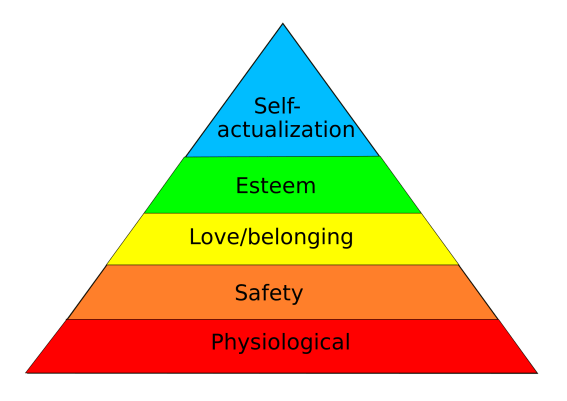
Maslow’s A Theory of Human Motivation states:

Esteem needs –‘All people in our society…have a need or desire for a stable, firmly based, (usually) high evaluation of themselves, for self-respect, or self-esteem, and for the esteem of others.  By firmly based self-esteem, we mean that which is soundly based upon real capacity, achievement and respect from others.  These needs may be classified into two subsidiary sets. These are, first, the desire for strength, for achievement, for adequacy, for confidence in the face of the world, and for independence and freedom.  Secondly, we have what we may call the desire for reputation or prestige…recognition, attention, importance or appreciation.’

I would further break down self-esteem into two categories, but my interpretation would first include how we feel and view ourselves and the other as the desire for the recognition of our strengths.  However, the first is NOT a motivation.  We are motivated to want prestige, fame, and acknowledgement, but self-esteem has never been a motivation for people.  People do not consciously know that they want to see themselves in a positive light, nor do they actively try to achieve this goal.  As children, we may or may not be encouraged to develop a sense of who we are, but many people vary in the degree of seeing how important self-esteem is.

First off, what is self-esteem?  How is it different from self-respect?  Is there a difference?  Yes.  Some people respect themselves highly and know they would never let someone else disparage them, but if they have low self-esteem, they may still believe it.  The two can exist independent of each other, however, those who have high self-esteem usually respect themselves as well and will usually also have high self-respect, but those who have low self-esteem can still respect their selves outside of who they are, which is also correlates to high self-respect. Whereas self-respect plays to how a person is treated by others, self-esteem plays to how a person treats themselves based on how they feel about themselves.  This is why it may be confusing at times when you confuse the two and mistake them for one another.

Some children are encouraged to enjoy who they are and they flourish.  Some may be discouraged, but more often than not, the majority are ambivalent, not because parents do not care, but because they don’t know how to encourage a reticent child.  As such, this insular world becomes even more insular as they internalize feelings and don’t understand the importance of self-esteem.  Because it is not a motivation, they do not build who they are.  They are still motivated to seek friends and love interests, but if they are not fulfilled internally by themselves, their relationships can be rocky because of this.  Many times, we are searching for a sense of ourselves throughout our journey and take on relationships we can’t comprehend in the search for what we want.  If we are not sure in who we are, we will be as equally unsure in who we want as a partner, causing rifts.

Some who are socially-withdrawn feel no need to develop their self-esteem.  They may regard themselves highly, but do not feel the need to elevate how they feel about themselves, thus they do not feel satisfied in this area and will not pursue other relationships or achievements because they feel as if they are not good enough.  They come up with reasons for this such as they despise human connections and they feel they are wasting their time and energy on useless things.  In actuality, humans crave relationships because they will undoubtedly feel lonely at some point despite their refusals.  Having self-esteem encourages these individuals to reach out to others because they feel they deserve relationships.

Why is it important?  It’s important because it serves as the basis of who we are.  When we have incredibly low self-esteem, we tend to accept less and feel fearful of other’s motivations and change in itself.  We are unsure of what the future will bring.  When we have high self-esteem, we welcome change and become more adaptable.  We have a more positive outlook on life and what comes our way.  Most importantly, we care about ourselves and are more in tune with who we are and what we want if we are honest with ourselves.  Ultimately, high self-esteem allows us to be the truest form of who we are and having pride in ourselves internally.

An example would be if a young adult asks someone out and gets rejected.  This is not a poor decision, but it retains a negative worth to them.  As such, they may let this memory eschew them and steer other decisions in their live.  We can tell them that at least they were brave enough to ask.  Some people go their whole lives without knowing a simple question, and they did ask.  The answer was no, but that doesn’t mean it doesn’t have meaning.  It means they were brave.  It means they have the ability to interact with others.  It means they have learned something.  When they don’t look upon the decision as shameful and fearful, they will see the pride of it and see pride in themselves.  This allows for them to see their decisions as positive memories that have enabled them to grow.

Maslow’s heirachy did not state that this was a strict hierarchy where each lower need had to be met before moving on to the next, but it was predicated on the belief that people are motivated to want self-esteem.  If people were motivated on this belief and chose to fulfill this need, they would definitely be able move on, but it is not a motivation.  Thus, some people who did not already possess high self-esteem would not be able to reach self-actualization.  The need for recognition and meaningful relationships would still exist, but these needs would not be fully realized if the person could not realize their own self worth.  What this results in is people searching for love, but either treat themselves or their partner badly because they feel they are not worthy.  Or they fail to advance at work because they fear change and authority.


How do we cultivate self-esteem?  Is it enough to just encourage children and tell them they are good?  No, because a parent can do this and a child can still have low self-esteem, which can be quite maddening for the parent.  The trick is teach them how to view their decisions and discuss them.  If it is a good decision, praise them for it and discuss how it affects those around them.  This allows for them to see how their actions affect not only them but those around them.  If they made a poor decision, we should talk about what went wrong, why it went wrong and how they felt about it.  Let them know the positives of a poor decision.  They at least have learned something from it.  They are wiser and richer for knowing it now.  The poor decisions are where we can cultivate the most self-esteem, which sounds counter-intuitive, but is not.  When we reinforce that poor decisions are part of the learning process, they see failure as necessary and not shameful.  When the shame is removed, they are able to see the nugget of good in the poor decision and learn from it.