A Return to American Values

retro-1291738__180

You hear a lot about restoring American and family values, but what are they exactly?  Many of the people who espouse this rhetoric usually want values and mores to turn back the clock to the fifties, which they see as a simpler time.   It was a simpler time in the context that the definitions of a man, woman, an enemy, a foreigner, and a family were neatly written out.  However, people were still agitating for equal rights for minorities and women, so this period is not as quaint as it has been glamorized by Hollywood.  So what exactly do the people who say this want?  They do not want that particular period, but they long for the time when you could easily define someone.

When you can easily define someone, you can see right away who doesn’t belong, and if someone were to question the status quo, they would be seen as not conforming.  That is what that time period was  all about: conforming to social norms.  When a large majority of society conforms, it makes it easier to flow through it because everyone understands their role and place.  When the lines are blurred, people are afraid of their own status and the status of others.  If you define yourself as a man and such a category as a transgender man exists, does this devalue who you are?  If you and your neighbors have always been one color and now the color of those around you start to change, who becomes the foreigner if you can’t tell each other apart?

Some people would say that these modern times have created more strife because of these new freedoms and views, and to this I would agree.  When there are more options, there will be more reasons to disagree and create factions in the people.  However, the opposite of this would be to return to the catchall term of ‘family values,’ where our identities are strictly defined, and when they are, people will be silently unhappy.  At least with more options, people can voice their opposition.  I think people are threatened by the changing definitions because they have to question who they are and the power they are losing by conceding the definitions to those they do not agree with.  As such, they point to the strife in modern society and claim it is because of modern values that this has happened, not acknowledging the strife that existed in the past.

I would rather live in a world where women are given the same opportunities as men, minorities are afforded the same rights as the majority, and the LGBT community is able to marry as with those who are straight than a world with stagnant definitions of who I am and who we are as a people.  When we redefine the rules of society, we do so to offer equality, but some see this as a redistribution of power, which they resent.  We can go back and live by these old rules, but in doing so, we undo our progress for the sake of conformity.  Values and Mores are not what sex we want to be with, how much we get paid, or equal access to education, but they are how we judge ourselves.  These things are rights, but they are not values.  I hope we will  judge ourselves as open and compassionate and our children will judge us as such when the time comes.

How to gain confidence

stock-photo-woman-hiker-on-a-top-of-a-mountain-221809534

We talk about confidence all the time, but it’s not as easy as you think.  You either have confidence or you don’t.  For those who don’t have it, it’s really hard to understand.  Confidence can be broken down into self-esteem and self-respect.  First off, what is self-esteem?  How is it different from self-respect?  Is there a difference?  Yes.  Some people respect themselves highly and know they would never let someone else disparage them, but if they have low self-esteem, they may still believe it.  The two can exist independent of each other, however, those who have high self-esteem usually respect themselves as well, but those who have low self-esteem can still respect their selves outside of who they are. Whereas self-respect plays to how a person is treated by others, self-esteem plays to how a person treats themselves based on how they feel about themselves.

Self-esteem is where true confidence lies.  People who have high self-respect may portray themselves as confident, but it is not complete unless they also have self-esteem.  So, how does one go about building their own self-esteem?  It’s not as easy as you think.  There is the old adage of believing in who you are but how do you get there if you don’t have the tools?  I find many people simply don’t believe in themselves.  They will not let someone walk all over them, but they walk all over themselves.  They believe they are not worthy and accept a defeatist attitude because they think they will fail anyways so they do not even attempt to try.  This is because they fear failure.  They fear looking like a fool.  They fear being laughed at because they are not good enough.

These are all internal fears.  They have no bearing on their actual strengths in the real world.  To believe in themselves, they must forgive themselves for embarrassing memories they still hold on to.  Out of all the memories you hold, why do you still vividly remember this moment?  Because you do, you can never let go of the guilt and shame attached to it.  It does you no good to hold on to it.  Instead, attach a good thought to it.  I used to remember certain events all the time such as why did I say that horrible thing to her that I shouldn’t have?  Then I attached the thought of ‘but that doesn’t make me a bad friend.  It was the truth, but I shouldn’t have said it and I have learned from it.’  When I thought back to this memory, I would think of the good note as well and soon enough, the memory faded from my mind because the shame and guilt disappeared with it   The memory itself does not change, but how you feel about it has.  We cannot control the past, but we can control how we feel about it.  When we can move past the shame and guilt, we are free to learn from the experience.

Once you have done this with past memories, you can build on the foundation of who you are.  You can do this by living faithfully to your own words.  How this works is that you simply try not to contradict yourself.  If you ever call someone selfish for not sharing, you will make sure that you share.  What this does is two-fold, for you will watch what you say about others and watch your own actions so you are not a hypocrite.  Some will say you can simply set really low standards and fulfill this, but even those people will contradict themselves eventually.  If you adhere strictly to your beliefs, you will gain self-confidence and pride in who you are.  You are conscience of others and accountable to your own words.  This system will set you up for success because if you feel sure of yourself because of your actions, others will perceive the same of you.

This is how confidence is built.  Oftentimes, you can tell a child ‘you’re so smart’ and think this instills confidence in them, but it does not.  They already know they are smart so you are not building their confidence.  They simply see this as a fact.  If you build on their negative experiences, you will get them to FEEL better about themselves.  If they ask a classmate out and are rejected, they may feel horrible about it and never ask anyone out again.  However, if you ask them to see the positive, they will feel good about the action.  If you tell them ‘you got an answer.  It’s not the answer you wanted to hear, but now you know.  Some people go their entire lives without ever knowing, but you had the courage to ask and you know.  Aren’t you proud of that?’  This gets them to see their mistakes in a positive light and they do not attach negative connotations to the memory then.  Confidence is not how we think about ourselves, but how we feel about ourselves.

How to attract love

peacock-1868__180

I’m not cut from the cloth of Rhonda Byrne’s The Secret.  I don’t believe that you can visualize what you want and it will come to you.  Attraction is about something unspoken and visceral.  You can feel it.  It seizes you and makes your heart palpitate.  Some confuse it for love, but it is merely a physical attribute.  Some also infer other attributes to a person who is attractive, which can be false.  For me, I strip down attraction to what it really is: the ability to engage someone based off your initial first impression.  What separates someone who is successful in this field to someone who is not?  I can tell you it’s not just their physical appearance. Although this plays a major role in determining a person’s attractiveness, a person who is not as attractive can become more successful if they are confident.

Let’s go through that quintessential moment where you first lock eye with someone. Within a few seconds, you are each sizing each other up and determining if you find this person attractive.  Deeper than that, you can feel how a person thinks about themselves by how they carry themselves and how confident they are.  Confidence is sexy because it means the person values themselves and many people want a prize.  They want someone that everyone else wants: someone who is hard to attain because they are valuable.  You can gage how valuable they are by how they value themselves.  If a person holds themselves to higher standards, it shows in every facet of who they are: their speak, their gestures, their walk, their mannerisms.  A person who is confident conveys it in their appearance, how they treat others, and how they allow themselves to be treated because they value who they are and others can see it as well in the span of a few seconds.

Confidence is the only defining factor that separates those who have a highly charged first impression from those who are also attractive but lacking confidence.  You can take twins, where one is more confident than the other and people will be naturally drawn to the confident one.  When you are confident, you will also attract people who are more confident as well.  This is the moment of attraction: when you lock eyes with someone and you don’t look away because you are so sure of who you are that you make them feel this as well.  This is attraction.  Attraction is not merely wanting something, but building who you are internally until it manifests externally so that others can sense who you are. This is true charisma.  The ability to believe wholly in yourself.  That is what people are attracted to

Subtext and Subterfuge

Dating in the Digital Age

cell-phone-1163722__180

Are there new rules now that technology has overrun our lives?  Do you still wait 3 days to call someone?  Do you like someone’s picture on Facebook?  Do you include them in a Snapchat?  Text has become our modus operandi.  Why?  It’s safe to reach out to someone over text and it’s so much easier to let them go over it.  Rejection is best served over emoji.  I like you, but as a friend.  Smiley emoji followed by heart followed by gun?  Actually, when my boyfriend called me for a date, I let it go to voicemail and texted him back because I panicked.  I texted him like a normal person who just happened to miss his call by chance.  The reality was that I was not comfortable with talking over the phone and texting gave me more time to craft my response.  For English-major nerds like me, this is the golden age of dating because I live for the written word.

We can be anyone we want. Appear to be witty.  Respond casually to show how much we don’t care.  And show how interested we are by what we put out in social media.  The dating inferences have just changed to digital.  In the past, we would actually just show up with our interest, but now, we can gauge each other’s interest by what we display on social media.  Did she just friend me accidently and then unfriend me?  Oh, yeah, you wants the D.  So our flirting is online.  Our interests are displayed online.  And our rejections are online.  And we can be harsh and unrelenting because the internet allows us to distance ourselves from actual people.  Now, people can end relationships by text and just erase their whole relationship picture by picture a la Eternal Sunshine for the Spotless Mind.  But who do we really erase when we do this?

We’re always in the habit of presenting our best selves, so we are constantly editing the online versions of ourselves.  Sometimes, we erase whole stretches of time from our lives because we don’t want to be reminded of an ex.  This can be cathartic or hurtful, but it allows us to have more control of our lives and we want to protect these carefully curated versions of who we are.  Although we intrude our lives into media, we must be careful to not let media intrude on our lives.  What does that mean?  We are free to post and text what we want, but when it comes to actual moments, we should live them IRL, including the good and the bad, because when you look back, you don’t want to remember scenes where you dumped someone over text but in person.  In the digital age, these things are merely tools to enhance our lives and means to convey our thoughts, but they should not act as our avatars.

What Women Want

portrait-841861__180

Through the centuries, the sexes have been embroiled in a war where guys can’t seem to understand what women want.  Women assume that men have the same thought patterns as we do and when men do not get the subtle hints we give them, we get mad.  We think we’re trying to so hard to put out clues for their benefit and are rubbed the wrong way when they don’t understand what we want.  Case in point, an acquaintance of mine went on a date with a guy where they were walking a trail.  Half-way through, she asked if he wanted to stop at a bench and sit.  He said that he wanted to keep going.  This is what is going on in our minds:

Women: Do you want to sit down? (so we can be close together and share the beautiful view.  I’d like you to put your arm around me and perhaps we can have a more intimate talk that is at a slower pace.

Men: No, I want to keep walking.  (No, I want to walking.)

That’s pretty much it.  We think that men think like us and that they should somehow know what we are implying and if they turn us down, it means they are turning our whole selves down and not just that one invitation.  Because of this, women will not contact a guy again.  This is what women want.  They want to feel wanted, and when their advances are rejected, they feel as if there is nothing there.  This does not mean women want to be ogled on the streets and fondled by every guy at the bar, but they want the guy they are interested in to want them.  So what do we do in this game?  Those who are in the know employ cold and hot tactics, seeing how the other reacts.  They flirt with someone else.  They ignore them.  We do all this to gauge how the other person feels without putting ourselves out there, but not all everyone know this.

Guys are not mind-readers, nor do they just automatically know what we are implying.  This can be quite confusing when it comes to potential intimate moments, when the protocol can be confusing.  Men are conditioned to accept a lady’s refusal because they are gentlemen, but at the same time, many women want him to push just a little further to show that he is interested.  What’s a guy to do?  You’re a creep if you do and you’re not interested if you don’t.  Here’s a good way for guys to approach this situation: ‘I respect you and your wishes and if you are saying no, I will honor that, but it doesn’t mean I don’t want you.’  And then leave.  What this does is put the ball in her court and she has to make the next move.

Ladies, even guys who are more socially-adept miss our cues.  And then, you get to the well-meaning guys who are a really good catch, but miss out on all the cues.  Please understand it is not because they are not interested, but because they don’t understand the whole dating game.  Even a suave guy will miss about 10% of your cues.  A regular guy will miss about 50%.  A guy who has barely dated will miss over 90%.  And what do we do?  We dismiss them because we think they are not intriguing because they can’t play the game, but the ones who know how to are the ones we are interested in because they leave us wanting more.  So we keep dating these guys and wonder where all the good guys are.

On one of our first dates, my boyfriend and I stopped at a food stand and he bought himself a hamburger but did not ask me if I wanted one.  I made fun of him years later for this and he said how was he to know that I wanted one, too?  If I wanted one, why didn’t I buy one myself or ask him to?  I told him it would’ve been rude of me to ask, but I thought he was incredibly rude to not even ask me.  I realized then that this guy who rarely dated before didn’t understand the social dating cues and it was not because he wasn’t interested in me, but because he just didn’t know.  If I didn’t know that, I may have stopped talking to him and then I wouldn’t have found out how great he was.  So the morale of the story is just because a guy can’t read what you’re trying to say doesn’t mean he’s not interested.

Help! My girlfriend is crazy!

Help! My girlfriend is crazy!

At some point or other, you have called a girl crazy.  But girls never call guys crazy, just ‘psycho’ or ‘serial killer.’  That’s a joke.  Hey, I like guys because clearly I’m with one, but the word crazy is something only used to describe women as emotionally unbalanced and hormonally-prone violent.  Now, I can admit there have been a time or two that I would throat-punch you if you said something wrong, but for the most part, being called crazy is just a tactic used by men to make women submit because they are being painted as unstable.  Here’s the secret:  sometimes, women just like men are irrational, but sometimes they’re not and they still get called crazy.

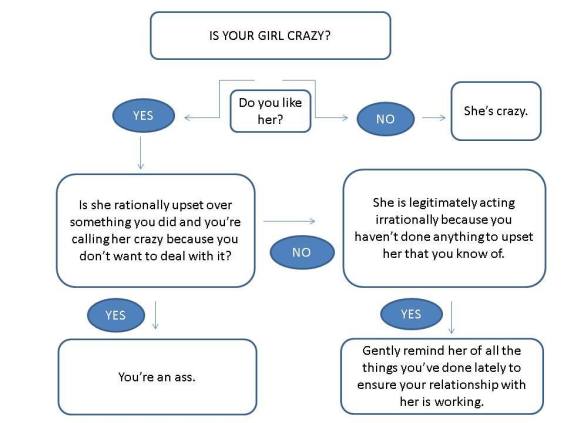
So I created this nifty flow chart to show how crazy works for dudes.  Helpful?  You’re damn right.  Guys, I get it.  You have to deal with women who may rape you on dates or possibly kill you if you leave them, so there’s a lot of crazy out there.  Oh, wait, that’s what women have to deal with?  And WE’RE the crazy ones?  I digress, but here’s how the chart works.  If you don’t like a woman, you can automatically categorize her as crazy because hey, you can give a flying shenanigan about her.  If you did care about her, you may still call her crazy, but is it because you know she’s on to something and just want to label her as crazy to throw her off?  That’s happened to me.  I thought an ex of mine was cheating on me and he said I was crazy.  Was he cheating on me?  You better believe he was.

13062377_1228784917139606_6081159334421407827_n

And then other times, she is irrational and it is not because you’re sidestepping an issue.  This legit can happen.  Let’s say you’ve had a normal day and all of a sudden she thinks you don’t care about her and you’ve done nothing to show her this.  This does happen from time to time and I want to explain this phenomenon.  Women tend to overthink things and they sometimes read too much into small gestures and they start to conjecture that their mate is somehow losing interest in them because they may feel insecure about themselves.  (This is why they would make great detectives.) It could not even be about the relationship, but something they are dealing with internally.  If this is the case, calmly sit her down and remind her of all the things you’ve done lately and assure her you’re in it for the long haul.

Why then are women being called crazy?  If a chick is crazy, you would not be involved with her.  If you did truly care for her, you would try to make her understand, but if you just want to avoid a situation, you may employ these tactics.  Of course not all guys do this, but it is something that occurs frequently enough that crazy is an adjective reserved only for women. And I get it, sometimes, a chick will key your car, but the chick that is with you who cares about you shouldn’t be labeled that.  All I know is that I have yet to throat-punch my boyfriend, but that’s because people think he’s a serial killer.  Edit: He is not a serial killer but a thoughtful boyfriend who enjoys my jokes.

Entitlement and Privlege

Entitlement and Privlege

This is what entitlement looks like.  Let’s look up the definition: the state or condition of being entitled to benefits.  Oftentimes, those who live in the upper class don’t want to acknowledge the monetary gap and call those who are poor entitled because they want access to food stamps and free healthcare.   They feel they can espouse these ‘truths’ because they THINK they have worked hard to reach where they are and don’t understand how others can’t reach their same level, even if they never spent a day working and were born into their riches.  This man is actually a slumlord and lied to get a 45 million-dollar loan.  He then passes this sense of entitlement on to his son, who goes on to berate an Uber driver based on the fact that he is rich and the driver is not.  Why?  Because it fosters their beliefs that they are entitled to their monetary gains and social status.  Because of their social status, they are granted entry into prestigious institutions and private clubs.  Because they are granted entry, they then feel a certain elitism and deride the poor for being poor.

This provides for class warfare, where the poor are made to believe they just need to work harder to achieve the status of their compatriots, never realizing these very people were given breaks to reach where they are.  In this case, this man completely fabricated his earnings to receive benefits he wasn’t entitled to, and yet a blue-collar worker is told to ‘pull yourself up by your bootstraps.’  This is a double trap for poverty-stricken minorities, because they then are questioned as to why they can’t overcome being poor and being a minority to reach the status of the elite.  It divides the class war into a race war and those who are entitled to white privileges do not understand what privileges they live with everyday to maintain their status.

What is white privilege?  You can see the divide between the classes, but some who are white cannot see their privilege.  This is because they are already benefiting from them and take it for granted.  If they were to see it from a minority point of view, they will see that they are not the norm.  When you are the minority, people question if you are really American, if you speak English, and why you are at a predominantly white establishment.  You get stares and questions that constantly remind you that you do not belong.  Band-Aids are skin-colored, but are they made for Black people?  If you are white, you probably never had to think about that because they were simply Band-Aids.  And you might think that these are minor points, but soon enough, all these minor points add up and it becomes major issues that bar minorities from higher education and possible careers.

How do you  fix such a system?  We can start by acknowledging that such a system exists and can be fixed.  Those who hold money and power will continue to feed lies to the lower classes to have them believe they need to work harder so they won’t revolt and begrudge them their riches.  They will also divide the lower classes into races so they will fight among themselves.  When the poorest of the poor are denied access to basic necessities, none of us prosper.  When we learn that we can only benefit from helping the neediest of our society, will we grow as a people.  If everyone is given access and education, they will find cures that we never thought of because their potentials will finally be released.  There is a revolution coming and those who fear it will do anything to stop change, but change is about ideas and not about tearing down physical walls.  When you tear down mental barriers, everything else will come crashing down.

The importance of Folklore

uncleboonmee

I believe all myths and folklore has some root in reality.  They range from the completely made up Loch Ness Monster to the delusionally-fueled Mermaids.  One origin of mermaids dates to when sailors mistook manatees for half human sirens calling to them.  Is it so preposterous then to believe other myths whose origin may spring from more likely sources?  In Southeast Asian cultures, many ethnic groups have stories of a Bigfoot-like creature who roamed the forests.  In Hmong culture, I grew up with dreams of Mahlews, giant, lumbering creatures that loomed in our imagination.  There is proof such an animal lived alongside humans thousands of years ago, but became extinct.  Perhaps, this ancestral memory of them has been passed down from generation to generation until it has become folklore instead of truth.

There has been evidence a creature called Gigantopithecus existed in southern China, Vietnam, and India, but went extinct 300,000 years ago.  Researchers estimate it stood more than 10 feet tall and weighed 1,200 pounds. ‘Scientists first learned of Gigantopithecus in 1935, when Ralph von Koenigswald, a German paleoanthropologist, walked into a pharmacy in Hong Kong and found an unusually large primate molar for sale.’ (1)  Since then, scientists have unearthed other bone fragments and continue to study them, but I feel they are not researching the history of the people who may have seen these creatures.

Hmong people originated in southern China and emigrated to the mountainous regions of Laos, close to Vietnam.  Thus, they would be greatly advantaged to have seen these beings in the past and have an oral history of them.  They are also featured as supernatural beings in a Thai-directed movie Uncle Boonmee Who Could Recall His Past Lives, showing how they permeate our cultures in different ways.  I have heard stories of these creatures along with many other fanciful beings all my life that I saw them all as characters from imaginative storytelling.  It’s hard to separate fact from fiction, but can it be that fact is so removed from time that it has now morphed into a fictionalized fact that is indistinguishable from fiction?

If this is the case, we shouldn’t be so quick to discount other folklore and explore them more thoroughly.  There is proof they existed when humans also did, so does this mean that when I am hearing about Mahlews, it is preserved ancestral knowledge passed down over the generations?  Obviously, no one has seen one in thousands of years, but perhaps our ancestors did and the knowledge is still with us today.  It certainly forces you to think that you shouldn’t be so quick to discount the basis of such folklore.  Folklore itself is precarious ground, but when you find such evidence as this to back it up, it makes quite a case for itself.

1.       http://www.smithsonianmag.com/science-nature/did-bigfoot-really-exist-how-gigantopithecus-became-extinct-16649201/?no-ist

2.       https://en.wikipedia.org/wiki/Gigantopithecus

3.       http://www.prehistoric-wildlife.com/species/g/gigantopithecus.html

4. picture from Uncle Boonmee who can recall his past lives